Social groups with diverse personalities mitigate physiological stress in a songbird


Vágási CI, Fülöp A, Osváth G, Pap PL, Pénzes J*, Benkő Z, Lendvai ÁZ and Barta Z 2021. Social groups with diverse personalities mitigate physiological stress in a songbird. Proceedings of the Royal Society of London B 288: 20203092. link

Media coverage: media #1 EN | media #2 EN | media #3 HU

Abstract

Social groups often consist of diverse phenotypes, including personality types, and this diversity is known to affect the functioning of the group as a whole. Social selection theory proposes that group composition (i.e. social environment) also influences the performance of individual group members. However, the effect of group behavioural composition on group members remains largely unexplored, and it is still contentious whether individuals benefit more in a social environment with homogeneous or diverse behavioural composition. We experimentally formed groups of house sparrows Passer domesticus with high and low diversity of personality (exploratory behaviour), and found that their physiological state (body condition, physiological stress and oxidative damage) improved with increasing group-level diversity of personality. These findings demonstrate that group personality composition affects the condition of group members and individuals benefit from social heterosis (i.e. associating with a diverse set of behavioural types). This aspect of the social life can play a key role in affiliation rules of social animals and might explain the evolutionary coexistence of different personalities in nature.
Posted in Uncategorized | Leave a comment

The Relationship between Hormones, Glucose, and Oxidative Damage Is Condition and Stress Dependent in a Free-Living Passerine Bird


Vágási CI, Tóth Z, Pénzes J*, Pap PL, Ouyang JQ and Lendvai ÁZ 2020. The Relationship between Hormones, Glucose and Oxidative Damage is Condition- and Stress-dependent in a Free-living Passerine Bird. Physiological and Biochemical Zoology 93: 466–476. link

Abstract

Physiological state is an emergent property of the interactions among physiological systems within an intricate network. Understanding the connections within this network is one of the goals in physiological ecology. Here, we studied the relationship between body condition, two neuroendocrine hormones (corticosterone and insulin-like growth factor 1 [IGF-1]) as physiological regulators, and two physiological systems related to resource metabolism (glucose) and oxidative balance (malondialdehyde). We measured these traits under baseline and stress-induced conditions in free-living house sparrows (Passer domesticus). We used path analysis to analyze different scenarios about the structure of the physiological network. Our data were most consistent with a model in which corticosterone was the major regulator under baseline conditions. This model shows that individuals in better condition have lower corticosterone levels; corticosterone and IGF-1 levels are positively associated; and oxidative damage is higher when levels of corticosterone, IGF-1, and glucose are elevated. After exposure to acute stress, these relationships were considerably reorganized. In response to acute stress, birds increased their corticosterone and glucose levels and decreased their IGF-1 levels. However, individuals in better condition increased their corticosterone levels more and better maintained their IGF-1 levels in response to acute stress. The acute stress–induced changes in corticosterone and IGF-1 levels were associated with an increase in glucose levels, which in turn was associated with a decrease in oxidative damage. We urge ecophysiologists to focus more on physiological networks, as the relationships between physiological traits are complex and dynamic during the organismal stress response.

Posted in Uncategorized | Leave a comment

Down feather morphology reflects adaptation to habitat and thermal conditions across the avian phylogeny


Pap PL, Vincze O, Daubner T*, Nord A and Vincze O 2020. Down feather morphology reflects adaptation to habitat and thermal conditions: a comparative study. Evolution 74: 2365–2376. link

Abstract

Down feathers are the first feather types that appear in both the phylogenetic and the ontogenetic history of birds. Although it is widely acknowledged that the primary function of downy elements is insulation, little is known about the interspecific variability in the structural morphology of these feathers, and the environmental factors that have influenced their evolution. Here, we collected samples of down and afterfeathers from 156 bird species and measured key morphological characters that define the insulatory properties of the downy layer. We then tested if habitat and climatic conditions could explain the observed between‐species variation in down feather structure. We show that habitat has a very strong and clearly defined effect on down feather morphology. Feather size, barbule length and nodus density all decreased from terrestrial toward aquatic birds, with riparian species exhibiting intermediate characters. Wintering climate, expressed as windchill (a combined measure of the ambient temperature and wind speed) had limited effects on down morphology, colder climate only being associated with higher nodus density in dorsal down feathers. Overall, an aquatic lifestyle selects for a denser plumulaceous layer, while the effect of harsh wintering conditions on downy structures appear limited. These results provide key evidence of adaptations to habitat at the level of the downy layer, both on the scale of macro‐ and micro‐elements of the plumage. Moreover, they reveal characters of convergent evolution in the avian plumage and mammalian fur, that match the varying needs of insulation in terrestrial and aquatic modes of life.

Posted in Uncategorized | Leave a comment

Morphological characterization of flight feather shafts in four bird species with different flight styles


Osváth G, Vincze O, David DC, Nagy LJ, Lendvai ZÁ, Nudds RL and Pap PL 2020. Morphological characterization of flight feather shafts in four bird species with different flight styles. Biological Journal of the Linnean Society 131: 192–202. link

Abstract

Variation in rachis (central shaft) morphology in individual remiges (flight feathers) within and among species reflects adaptations to requirements imposed by aerodynamic forces, but the fine-scale variation of feather morphology across remiges is not well known. Here we describe how the shape of the rachis, expressed by the height/width ratio, changes along the longitudinal and lateral axis of the wing in four bird species with different flight styles: flapping-soaring (white storks), flapping-gliding (common buzzards), passerine-type (house sparrows) and continuous flapping (pygmy cormorants). Overall, in each wing feather, irrespective of species identity, rachis shape changed from circular to rectangular, from the base towards the feather tip. The ratio between the height and width of the calamus was similar across remiges in all species, whereas the ratio at the base, middle and tip of the rachis changed among flight feathers and species. In distal primaries of white storks and common buzzards, the ratio decreased along the feather shaft, indicating a depressed (wider than high) rachis cross section towards the feather tip, whereas the inner primaries and secondaries became compressed (higher than wide). In house sparrows, the rachis was compressed in each of the measurement points, except at the distal segment of the two outermost primary feathers. Finally, in pygmy cormorants, the width exceeds the height at each measurement point, except at the calamus. Our results may reflect the resistance of the rachis to in-plane and out-of-plane aerodynamic forces that vary across remiges and across study species. A link between rachis shape and resistance to bending from aerodynamic forces is further indicated by the change of the second moment of areas along the wing axes.

Keywords: Buteo buteo, Ciconia ciconia, flight style, Microcarbo pygmaeus, Passer domesticus, rachis morphology, rachis shape, rachis width, second moment of area, wing feather

Posted in Uncategorized | Leave a comment

Selection on multiple sexual signals in two Central and Eastern European populations of the barn swallow


Pap PL, Fülöp A, Adamkova M, Cepak J, Michalkova R, Saffran RJ, Stermin AN, Tomasek O, Vágási CI, Vincze O, Wilins MR and Albtrecht T 2019. Selection on multiple sexual signals in two Central- and Eastern-European populations of the barn swallow. Ecology and Evolution 9: 11277–11287. link

Abstract

Variation in intensity and targets of sexual selection on multiple traits has been suggested to play a major role in promoting phenotypic differentiation between populations, although the divergence in selection may depend on year, local conditions or age. In this study, we quantified sexual selection for two putative sexual signals across two Central and East European barn swallow (Hirundo rustica rustica) populations from Czech Republic and Romania over multiple years. We then related these differences in selection to variation in sexual characters among barn swallow populations. Our results show that tail length and ventral coloration vary between populations, sexes, and age classes (first‐time breeders vs. experienced birds). We found that selection on tail length was stronger in first‐time breeders than in experienced birds and in males than in females in the Romanian population, while these differences between age groups and sexes were weak in Czech birds. We suggest that the populational difference in selection on tail length might be related to the differences in breeding conditions. Our results show that ventral coloration is darker (i.e., has lower brightness) in the Romanian than in the Czech population, and in experienced birds and males compared with first‐time breeders and females, respectively. The sexual difference in ventral coloration may suggest sexual selection on this trait, which is supported by the significant directional selection of ventral coloration in first‐time breeding males on laying date. However, after controlling for the confounding effect of wing length and tarsus length, the partial directional selection gradient on this trait turned nonsignificant, suggesting that the advantage of dark ventral coloration in early breeding birds is determined by the correlated traits of body size. These findings show that ventral coloration may be advantageous over the breeding season, but the underlying mechanism of this relationship is not clarified.

Posted in Uncategorized | Leave a comment

Wing morphology, flight type and migration distance predict accumulated fuel load in birds


Authors marked in boldface are EvolEcol members.

Vincze O, Vágási CI, Pap PL, Palmer C, Møller AP 2018. Wing morphology, flight type and migration distance predict accumulated fuel load in birds. Journal of Experimental Biology (in press).

Abstract
Birds often accumulate large fat and protein reserves to fuel long-distance flights. While it is well known that species that fly the longest accumulate the largest amounts of fuel, considerable cross-species variation in fuel load is seen after controlling for overall migration distance. It remains unclear whether this variation can be explained by aerodynamic attributes of different species, despite obvious ecological and conservation implications. Here we collected data on wing morphology, flight type, migration distance and fuel load from 213 European bird species and explored three questions: (1) Does maximum fuel load relate to migration distance across species?; (2) Does wing morphology, as described by wing aspect ratio and wing loading, influence maximum fuel load, and; (3) Does flight type influence maximum fuel load? Our results indicate that maximum fuel load increases with migration across species, but residual variance is high. Our results indicate that maximum fuel load is also correlated with migration distance, but again residual variance is high. The latter variance is explained by aspect ratio and flight type, while wing loading and body mass explain little variance. Birds with slender wings accumulate less fuel than species with low wing aspect ratio when covering a similar migration distance. Continuously flapping species accumulate the largest amounts of fuel, followed by flapping and soaring, flapping and gliding species, while the smallest fuel loads were observed in birds with passerine-type flight. These results highlight complex eco-evolutionary adaptations to migratory behaviour, pointing toward the importance of energy-minimisation.

Key-words: aspect ratio; fat reserves; flight range; flight type; wing loading

Posted in Uncategorized | Leave a comment

Vane macrostructure of primary feathers and its adaptations to flight in birds


Authors marked in boldface are EvolEcol members. Authors with asterisk are undergrad students.

Pap PL, Vincze O, Vágási CI, Salamon Z*, Pándi A*, Bálint B*, Nord A, Nudds RL, Osváth G 2018. Vane macrostructure of primary feathers and its adaptations to flight in birds. Biological Journal of the Linnean Society (in press).

Abstract
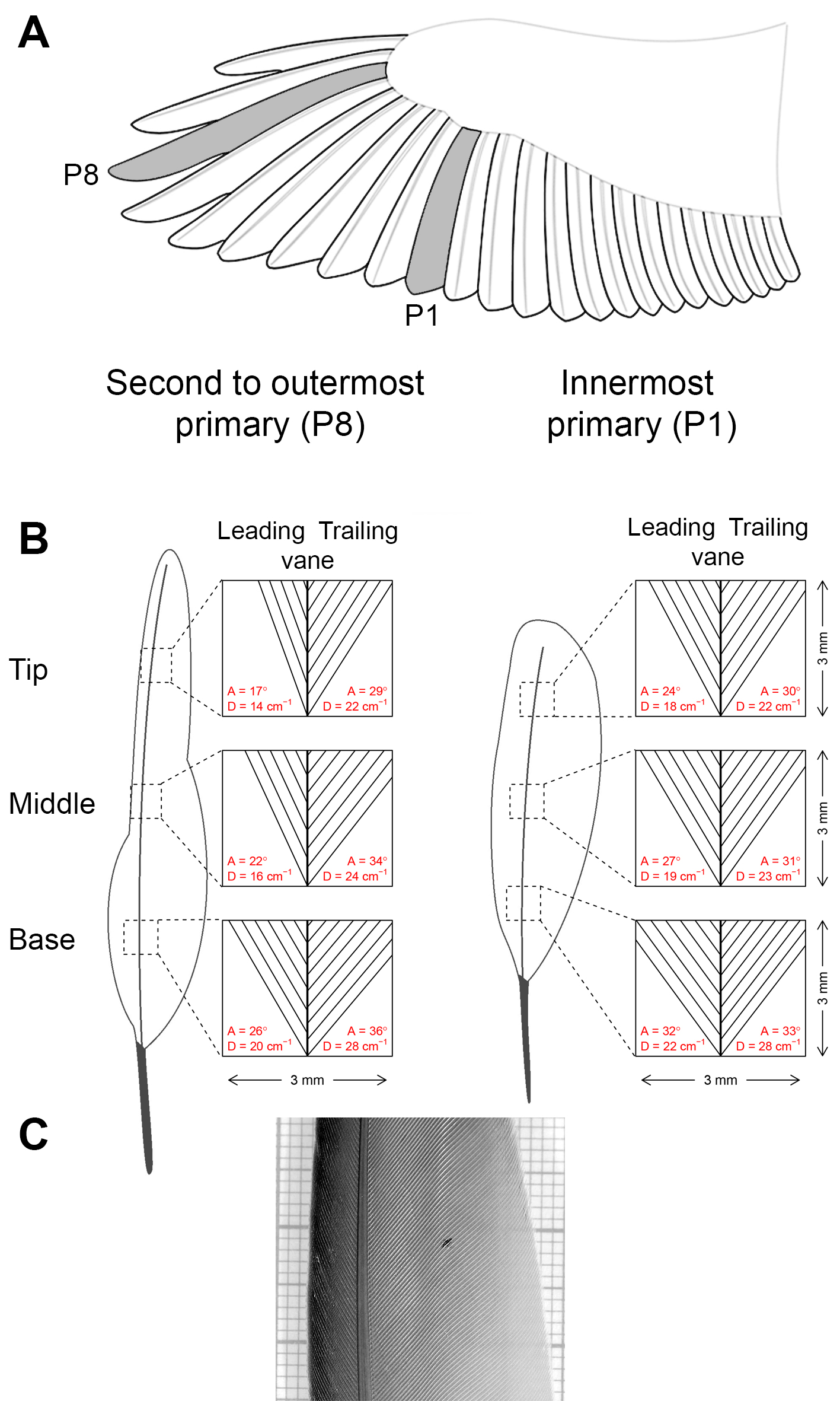
The selection pressures that drive flight feather morphology are poorly understood. Using a phylogenetic comparative approach and data from 178 species of birds, we investigated whether both the position along the wing length and flight feather length affected vane structure. We found that barb density was lower on distal primaries than proximal primaries of the leading feather vane. In contrast, on the trailing vane only the mid point barb density differed and, here, it showed denser barbs on the distal primaries. This difference was a denser at the feather base than the tip. Barb angle was higher along the full length of the leading edge vane on the proximal than compared with the distal primaries. Overall, barb density decreased from base to tip on both trailing and leading vanes on both the proximal and distal primaries. In general barb angle was less acute at the feather base than at the tip. Broadly, barbs were denser in continuous flapping fliers than in soarers and the angle of barbs on both the proximal and distal primaries was affected by flight type. We could not, however, identify consistent differences in the pattern of barb angle change among flight style groups. Our findings add new perspectives to our understanding of the functional morphology of flight feather vane, but we still have limited knowledge on how aerodynamic forces, particularly during take-off and landing, affect the morphology of the feather vane.

Additional keywords: barb angle – barb density – flight – flight feathers – functional morphology – feather vane

figure1_suppl_new

Posted in Uncategorized | Leave a comment

Longevity and life history coevolve with oxidative stress in birds


Authors marked in boldface are EvolEcol members. Authors with asterisk are undergrad students.

Vágási CI, Vincze O, Pătraș L, Osváth G, Pénzes J*, Haussmann MF, Barta Z, Pap PL 2018. Longevity and life history coevolve with oxidative stress in birds. Functional Ecology (in press).

Summary
1. The mechanisms that underpin the evolution of ageing and life histories remain elusive. Oxidative stress, which results in accumulated cellular damages, is one of the mechanisms suggested to play a role.
2. In this paper we set out to test the ‘oxidative stress theory of ageing’ and the ‘oxidative stress hypothesis of life histories’ using a comprehensive phylogenetic comparison based on an unprecedented dataset of oxidative physiology in 88 free-living bird species.
3. We show for the first time that bird species with longer lifespan have higher non-enzymatic antioxidant capacity and suffer less oxidative damage to their lipids. We also found that bird species featuring a faster pace-of-life either feature lower non-enzymatic antioxidant capacity or are exposed to higher levels of oxidative damage, while adult annual mortality does not relate to oxidative state.
4. These results reinforce the role of oxidative stress in the evolution of lifespan and also corroborate the role of oxidative state in the evolution of life histories among free-living birds.

Key-words: ageing, antioxidants, comparative biology, life history, lifespan, lipid peroxidation, mortality, oxidative damage

Posted in Uncategorized | Leave a comment

Autumn passage of soaring birds over Dobrogea (Romania): a migration corridor in Southeast Europe


Authors marked in boldface are EvolEcol members.

Fülöp A, Daróczi SJ, Dehelean AS, Dehelean LA, Domahidi Z, Dósa A, Gyékény G, Hegyeli Z, Kis RB, Komáromi IS, Kovács I, Miholcsa T, Nagy AA, Nagy A, Ölvedi SZ, Papp T, Pârâu LG, Sándor AK, Sos T, Zeitz R 2018. Autumn passage of soaring birds over Dobrogea (Romania): a migration corridor in Southeast Europe. Ardea 106: 61-77.

Abstract

The Dobrogea region in southeastern Romania, which is part of the Eurasian- East African Flyway, is listed as one of the important migration corridors for soaring birds on the western coast of the Black Sea. However, our knowledge regarding migration intensity, phenology and geographical patterns of soaring birds over the area is poor. To determine the migration intensity and phenology of soaring birds, we recorded the autumn migration in the Măcin Mountains (northern Dobrogea) from mid-August to the end of October between 2002–2007. To describe the geographical patterns of migration at a regional scale, we recorded migration intensity in the second half of September in 2010 and 2011, simultaneously from 15 and 13 counting points, respectively, covering the entire region of Dobrogea. In the Măcin Mountains we recorded a mean number (±SD) of 11,297 ± 2333.5 (CV = 20.7%) migrating raptors per year, and of 21,367 ± 10,949.3 (51.2%) and 455.6 ± 43.6 (9.6%) migrating White Storks Ciconia ciconia and Black Storks Ciconia nigra, respectively. Migration phenology parameters varied across raptor and non-raptor species. Migration occurred over a broad front, covering all of Dobrogea. However, migration intensity was more pronounced in the western, central and eastern parts of the region, and was less intensive in the northern central areas. Overall, we recorded 30 migrating raptor species and three non-raptor species. The most abundant raptors were Common Buzzard Buteo buteo, European Honey Buzzard Pernis apivorus, Lesser Spotted Eagle Clanga pomarina, Eurasian Sparrowhawk Accipiter nisus and Western Marsh Harrier Circus aeruginosus. The three non-raptor species were White Stork, Black Stork and Great White Pelican Pelecanus onocrotalus. Our study provides the first general overview of the autumn passage of soaring birds over Dobrogea, highlighting the importance of this area as part of a global migration network.

Posted in Uncategorized | Leave a comment

Demographic causes of adult sex ratio variation and their consequences for parental cooperation


Author marked in boldface is EvolEcol member.

L.J. Eberhart-Phillips, C. Küpper, M.C. Carmona-Isunza, O. Vincze, S. Zefania, M. Cruz-López, A. Kosztolányi, T.E.X. Miller, Z. Barta, I.C. Cuthill, T. Burke, T. Székely, J.I. Hoffman, O. Krüger (2018). Demographic causes of adult sex ratio variation and their consequences for parental cooperation. Nature Communications 9, 1651.

Abstract

The adult sex ratio (ASR) is a fundamental concept in population biology, sexual selection, and social evolution. However, it remains unclear which demographic processes generate ASR variation and how biases in ASR in turn affect social behaviour. Here, we evaluate the demographic mechanisms shaping ASR and their potential consequences for parental cooperation using detailed survival, fecundity, and behavioural data on 6119 individuals from six wild shorebird populations exhibiting flexible parental strategies. We show that these closely related populations express strikingly different ASRs, despite having similar ecologies and life histories, and that ASR variation is largely driven by sex differences in the apparent survival of juveniles. Furthermore, families in populations with biased ASRs were predominantly tended by a single parent, suggesting that parental cooperation breaks down with unbalanced sex ratios. Taken together, our results indicate that sex biases emerging during early life have profound consequences for social behaviour.

Fulltext avalaibe here.

Posted in Uncategorized | Leave a comment