Fülöp A, Lukács D and Barta Z 2022. Space use of wintering Eurasian Tree Sparrows (Passer montanus) in a semi-urban area: a radiotelemetry-based case study. Ornis Hungarica 30(2): 124–133. link
Abstract
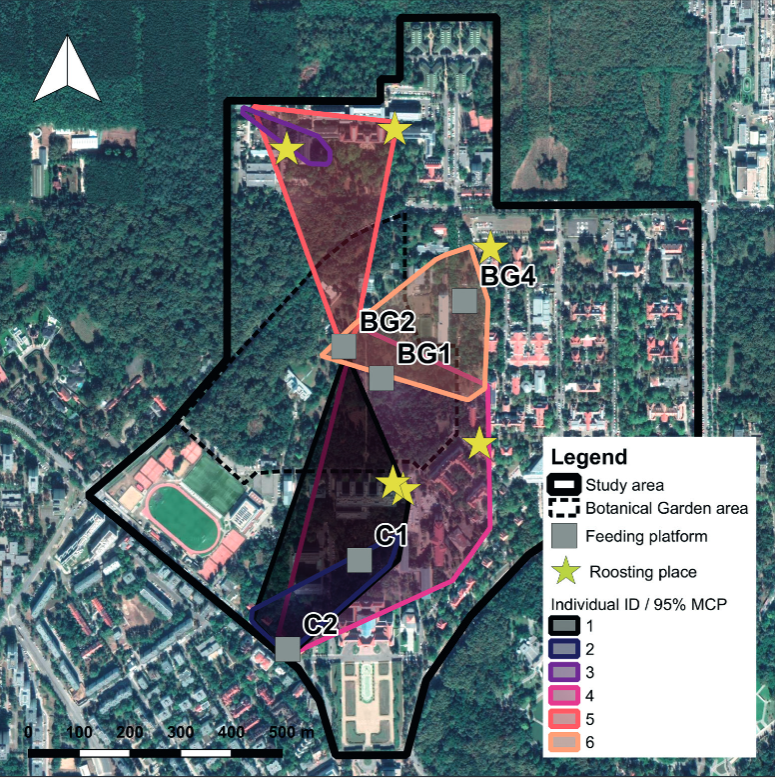
Space use, which includes the home range and habitat utilisation pattern of individuals for different activities (e.g. foraging, roosting), is one of the fundamental aspects of a species ecology. Hence, knowledge on the different aspects of space use in general is essential to understand the relationship between species and their habitat. Here, we investigated the home range size (using the minimum convex polygon method; MCP) and roosting site selection, using radiotelemetry, in a sedentary passerine species, the Eurasian Tree Sparrows (Passer montanus). The study was carried out during the non-breeding period (i.e. wintering), in a semi-urban habitat where supplemental feeding was also available. We found that individuals had highly variable home ranges, both in shape and size (mean ± SD of 95% MCP: 6.89 ± 5.73 ha), the location of which was influenced by the presence of bird feeders. Roosting sites of the tracked individuals were largely consistent at an individual level, that is, all birds used the same locations for roosting during the whole tracking period, and the roosting sites of all individuals were located on buildings, except for a few rare occasions. Our results suggest that urbanised habitats can provide multiple benefits for the individuals during the winter in the form of easily accessible resources (e.g. food, roosting place), and individuals readily exploit these resources by adjusting their space use according to their availability.
Keywords: home range, roosting, radiotelemetry, Passer montanus