Paper on functional morphology of body feathers accepted in Functional Ecology


Authors marked in boldface are EvolEcol members, authors with asterisk are undergrad students.

Pap PL, Vincze O, Wekerle B*, Daubner T*, Vágási CI, Nudds RL, Dyke GJ and Osváth G 2017. A phylogenetic comparative analysis reveals correlations between body feather structure and habitat. Functional Ecology (in press).

Summary
1. Body feathers ensure both waterproofing and insulation in waterbirds, but how natural variation in the morphological properties of these appendages relates to environmental constraints remains largely unexplored. Here, we test how habitat and thermal condition affect the morphology of body feathers using a phylogenetic comparative analysis of five structural traits [i.e., total feather length, the lengths of the pennaceous (distal) and plumulaceous (proximal) sections, barb density, and pennaceous barbule density] from a sample of 194 European bird species.
2. Body feather total length is shorter in aquatic than in terrestrial birds, and this difference between groups is due to the shorter plumulaceous feather section in aquatic birds. Indeed, a reduced plumulaceous section in feather length probably reflects the need to limit air trapped in the plumage to adjust the buoyancy of aquatic birds. In contrast, the high pennaceous barbule density of aquatic birds compared to their terrestrial counterparts reflects water resistance of the plumage in contact with water.
3. Our results show that birds living in environments with low ambient temperature have long plumulaceous feather lengths, low barb density, and low pennaceous barbule density. Data also suggest that plumage probably has limited function in reducing the heat absorption of species living in hot environments.
4. Our results have broad implications for understanding the suite of selection pressures driving the evolution of body feather functional morphology. It remains to be tested, however, how other feather traits, such as the density of plumage (feathers per unit area) and the relative number of different feather types, for example downy feathers, are distributed amongst birds with different water resistance and thermoinsulative needs.

Key-words: body feathers, feather lengths, functional morphology, thermal insulation, vane density, water repellence
body_feather

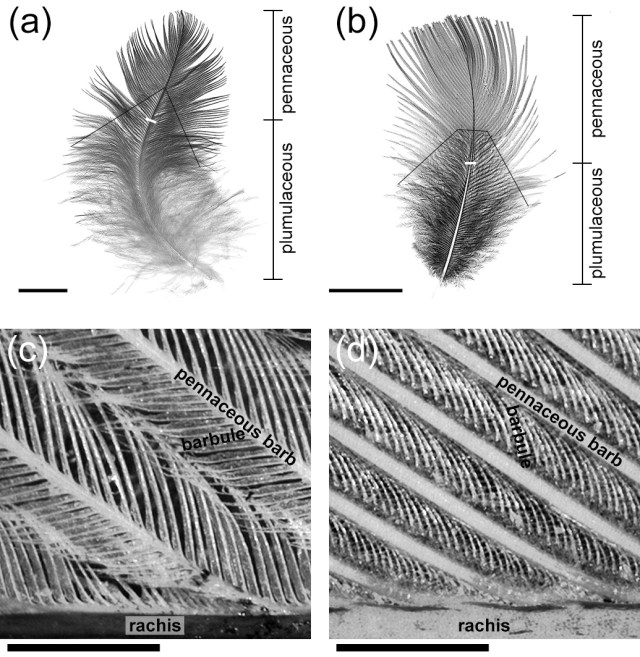
Figure 1. Different parts of a body feather with distal pennaceous and proximal plumulaceous sections delimited by a white stripe across the rachis at the base of the barb in which the length was at least 33% plumulaceus. The black lines define the boundary of the pennaceous and plumulaceous sections of the vane (a,b). Upper figures show two typical species with the ratio of the pennaceous feather section to plumulaceous part. In the Common Raven (Corvus corax), a terrestrial species, the plumulaceous part is longer (a), while in the Common Moorhen (Gallinula chloropus), an aquatic bird, this feather part is reduced in length (b). Lower figures illustrate a section of pennaceous vane with the rachis and barb to which the barbules attach. The density of pennaceous barbules are lower in terrestrial species, such as the Common Buzzard (Buteo buteo) (c) than in aquatic birds, represented here by the Northern Pintail (Anas acuta) (d). Scale bars for figures (a) and (b) are 1 cm, and for (c) and (d) are 0.5 mm.
Posted in Uncategorized | Leave a comment

Paper on diversity of parental care rhythms in shorebirds published in Nature


Bulla M, M Valcu, AM Dokter, AG Dondua, A Kosztolányi, A Rutten, B Helm, BK Sandercock, B Casler, BJ Ens, CS Spiegel, CJ Hassell, C Küpper, C Minton, D Burgas, DB Lank, DC Payer, EY Loktionov, E Nol, E Kwon, F Smith, HR Gates, H Vitnerová, H Prüter, JA Johnson, JJH St Clair, J-F Lamarre, J Rausch, J Reneerkens, JR Conklin, J Burger, J Liebezeit, J Bêty, JT Coleman, J Figuerola, JCEW Hooijmeijer, JA Alves, JAM Smith, K Weidinger, K Koivula, K Gosbell, L Niles, L Koloski, L McKinnon, L Praus, M Klaassen, M-A Giroux, M Sládeček, ML Boldenow, M Exo, MI Goldstein, M Šálek, N Senner, N Rönkä, N Lecomte, O Gilg, O Vincze, OW Johnson, PA Smith, PF Woodard, PS Tomkovich, P Battley, R Bentzen, RB Lanctot, R Porter, ST Saalfeld, S Freeman, SC Brown, S Yezerinac, T Székely, T Piersma, T Montalvo, V Loverti, V-M Pakanen, W Tijsen, B Kempenaers 2016. Unexpected diversity in socially synchronized rhythms of shorebirds. Nature (in press).

Abstract: The behavioural rhythms of organisms are thought to be under strong selection, influenced by the rhythmicity of the environment1,2,3,4. Such behavioural rhythms are well studied in isolated individuals under laboratory conditions1,5, but free-living individuals have to temporally synchronize their activities with those of others, including potential mates, competitors, prey and predators6,7,8,9,10. Individuals can temporally segregate their daily activities (for example, prey avoiding predators, subordinates avoiding dominants) or synchronize their activities (for example, group foraging, communal defence, pairs reproducing or caring for offspring)6,7,8,9,11. The behavioural rhythms that emerge from such social synchronization and the underlying evolutionary and ecological drivers that shape them remain poorly understood5,6,7,9. Here we investigate these rhythms in the context of biparental care, a particularly sensitive phase of social synchronization12 where pair members potentially compromise their individual rhythms. Using data from 729 nests of 91 populations of 32 biparentally incubating shorebird species, where parents synchronize to achieve continuous coverage of developing eggs, we report remarkable within- and between-species diversity in incubation rhythms. Between species, the median length of one parent’s incubation bout varied from 1–19 h, whereas period length—the time in which a parent’s probability to incubate cycles once between its highest and lowest value—varied from 6–43 h. The length of incubation bouts was unrelated to variables reflecting energetic demands, but species relying on crypsis (the ability to avoid detection by other animals) had longer incubation bouts than those that are readily visible or who actively protect their nest against predators. Rhythms entrainable to the 24-h light–dark cycle were less prevalent at high latitudes and absent in 18 species. Our results indicate that even under similar environmental conditions and despite 24-h environmental cues, social synchronization can generate far more diverse behavioural rhythms than expected from studies of individuals in captivity5,6,7,9. The risk of predation, not the risk of starvation, may be a key factor underlying the diversity in these rhythms.

24924761

Posted in Uncategorized | Leave a comment

Environmental selection is a main driver of divergence in house sparrows (Passer domesticus) in Romania and Bulgaria


This paper is now online and can be accessed here:

http://onlinelibrary.wiley.com/doi/10.1002/ece3.2509/full

Posted in Uncategorized | Leave a comment

Paper on landscape genetics of house sparrows accepted in Ecology and Evolution


Geue JC, Vágási CI, Schweizer M, Pap PL and Thomassen HA 2016. Environmental selection is a main driver of divergence in house sparrows (Passer domesticus) in Romania and Bulgaria. Ecology and Evolution (in press).

Abstract: Both neutral and adaptive evolutionary processes can cause population divergence, but their relative contributions remain unclear. We investigated the roles of these processes in population divergence in house sparrows (Passer domesticus) from Romania and Bulgaria, regions characterized by high landscape heterogeneity compared to Western Europe. We asked whether morphological divergence, complemented with genetic data in this human commensal species was best explained by environmental variation, geographic distance, or landscape resistance ‒ the effort it takes for an individual to disperse from one location to the other ‒ caused by either natural or anthropogenic barriers. Using generalized dissimilarity modeling, a matrix regression technique that fits biotic beta diversity to both environmental predictors and geographic distance, we found that a small set of climate and vegetation variables explained up to ~30% of the observed divergence, whereas geographic and resistance distances played much lesser roles. Our results are consistent with signals of selection on morphological traits and of isolation by adaptation in genetic markers, suggesting that selection by natural environmental conditions shapes population divergence in house sparrows. Our study thus contributes to a growing body of evidence that adaptive evolution may be a major driver of diversification.

fig

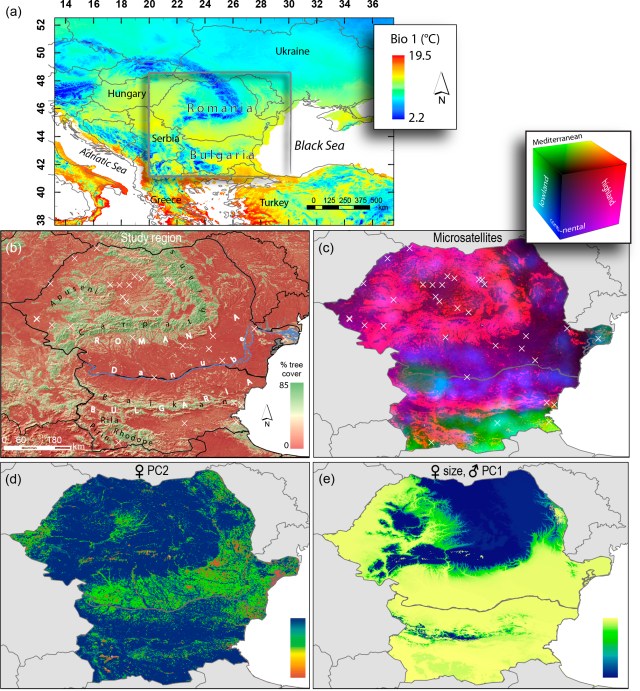
Fig. 1 Study region, sampling sites, and generalized dissimilarity modeling (GDM) results. (a) Location of the study region within Eastern Europe, with average temperature of the year (Bio 1). (b) Overview of the study area, with sampling sites (crosses) on a hillshade map and an overlay of percent tree cover. (c-e) GDM results for the second morphological shape component for females (c), the morphological size component in females and the first shape component for males (d), and microsatellites (e). The color difference between two locations along the color bar (c, d), or on the RGB color cube (e) in the GDM maps represents the magnitude of the difference in the biotic response variable, i.e. morphological variable or FST.

Posted in Uncategorized | Leave a comment

Paper on sexual selection and phenotypic differentiation in barn swallows accepted in Journal of Evolutionary Biology


Wilkins MR, Karaardıç H, Vortman Y, Parchman TL, Albrecht T, Petrželková A, Özkan L, Pap PL, Hubbard JK, Hund AK and Safran RJ 2016. Phenotypic differentiation is associated with divergent sexual selection among closely related barn swallow populations. Journal of Evolutionary Biology (in press).

Abstract: Sexual selection plays a key role in the diversification of numerous animal clades and may accelerate trait divergence during speciation. However, much of our understanding of this process comes from phylogenetic comparative studies, which rely on surrogate measures such as dimorphism that may not represent selection in wild populations. In this study, we assess sexual selection pressures for multiple male visual signals across four barn swallow (Hirundo rustica) populations. Our sample encompassed 2400 linear km and two described subspecies: European H. r. rustica (in the Czech Republic and Romania) and Eastern Mediterranean H. r. transitiva (in Israel), as well as a potential area of contact (in Turkey). We demonstrate significant phenotypic differentiation in four sexual signaling axes, despite very low-level genomic divergence and no comparable divergence in an ecological trait. Moreover, the direction of phenotypic divergence is consistent with differences in sexual selection pressures among subspecies. Thus, H. r. transitiva, which have the darkest ventral plumage of any population, experience directional selection for darker plumage. Similarly, H. r. rustica, which have the longest tail feathers of any population, experience directional selection for elongated tail feathers and disruptive selection for ventral plumage saturation. These results suggest that sexual selection is the primary driver of phenotypic differentiation in this species. Our findings add to growing evidence of phenotypic divergence with gene flow. However, to our knowledge, this is the first study to relate direct measures of the strength and targets of sexual selection to phenotypic divergence among closely-related wild populations.

Posted in Uncategorized | Leave a comment

Genome-wide differentiation in closely related populations: the roles of selection and geographic isolation


This paper is now online and can be accessed here:

http://onlinelibrary.wiley.com/doi/10.1111/mec.13740/abstract

Posted in Uncategorized | Leave a comment

Paper on brain size evolution and migration accepted in Evolution


Orsolya Vincze, a former EvolEcol group member, now PhD candidate at the University of Debrecen, published a great paper in Evolution on the evolution of brain size in birds according to their migratory behaviour. Her results come from a phylogenetic comparative study based on an impressive data set, 1466 globally distributed bird species.

http://onlinelibrary.wiley.com/doi/10.1111/evo.13012/abstract

Vincze O 2016. Light enough to travel or wise enough to stay? Brain size evolution and migratory behaviour in birds. Evolution (in press).

Abstract: Brain size relative to body size is smaller in migratory than in non-migratory birds. Two mutually non-exclusive hypotheses had been proposed to explain this association. On the one hand, the ‘energetic trade-off hypothesis’ claims that migratory species were selected to have smaller brains because of the interplay between neural tissue volume and migratory flight. In contrast, the ‘behavioural flexibility hypothesis’ argues that resident species are selected to have higher cognitive capacities, and therefore larger brains, to enable survival in harsh winters, or to deal with environmental seasonality. Here, I test the validity and setting of these two hypotheses using 1,466 globally distributed bird species. First, I show that the negative association between migration distance and relative brain size is very robust across species and phylogeny. Second, I provide strong support for the energetic trade-off hypothesis, by showing the validity of the trade-off among long-distance migratory species alone. Third, using resident and short-distance migratory species, I demonstrate that environmental harshness is associated with enlarged relative brain size, therefore arguably better cognition. My study provides the strongest comparative support to date for both the energetic trade-off and the behavioural flexibility hypotheses, and highlights that both mechanisms contribute to brain size evolution, but on different ends of the migratory spectrum.

Keywords: Migration; cognition; behavioural flexibility; energy trade-off; innovation

Posted in Uncategorized | Leave a comment

Large-brained birds suffer less oxidative damage


Our paper is now online and can be accessed here:

http://onlinelibrary.wiley.com/doi/10.1111/jeb.12920/abstract

Posted in Uncategorized | Leave a comment

Paper on genom-wide differentiation by adaptation and isolation in barn swallows accepted in Molecular Ecology


Genome-wide differentiation in closely related populations: the roles of selection and geographic isolation

Author marked in bold is EvolEcol member.

Safran RJ, Scordato ESC, Wilkins MR, Hubbard JK, Jenkins BR, Albrecht T, Flaxman SM, Karaardıç H, Vortman Y, Lotem A, Nosil P, Pap P, Shen S, Chan SF, Parchman T and Kane NC 2016. Genome-wide differentiation in closely related populations: the roles of selection and geographic isolation. Molecular Ecology (in press).

Abstract: Population divergence in geographic isolation is due to a combination of factors. Natural and sexual selection may be important in shaping patterns of population differentiation, a pattern referred to as ‘Isolation by Adaptation’ (IBA). IBA can be complementary to the well-known pattern of ‘Isolation by Distance’ (IBD), in which the divergence of closely related populations (via any evolutionary process) is associated with geographic isolation. The barn swallow Hirundo rustica complex comprises six closely related subspecies, where divergent sexual selection is associated with phenotypic differentiation among allopatric populations. To investigate the relative contributions of selection and geographic distance to genome-wide differentiation, we compared genotypic and phenotypic variation from 350 barn swallows sampled across eight populations (28 pairwise comparisons) from four different subspecies. We report a draft whole genome sequence for H. rustica, to which we aligned a set of 9,493 single nucleotide polymorphisms (SNPs). Using statistical approaches to control for spatial autocorrelation of phenotypic variables and geographic distance, we find that divergence in traits related to migratory behavior and sexual signaling, as well as geographic distance together, explain over 70% of genome-wide divergence among populations. Controlling for IBD, we find 42% of genome-wide divergence is attributable to IBA through pairwise differences in traits related to migratory behavior and sexual signaling alone. By (i) combining these results with prior studies of how selection shapes morphological differentiation and (ii) accounting for spatial autocorrelation, we infer that morphological adaptation plays a large role in shaping population-level differentiation in this group of closely related populations.

Posted in Uncategorized | Leave a comment

Paper about brain size and oxidative balance in birds accepted in Journal of Evolutionary Biology


Authors marked in bold are EvolEcol members. Authors with asterisk were undergrad students during the time of the study and/or manuscript writing.

Vágási CI, Vincze O*, Pătraș L*, Osváth G, Marton A*, Bărbos L*, Sol D and Pap PL 2016. Large-brained birds suffer less oxidative damage. Journal of Evolutionary Biology (in press).

Abstract: Large brains (relative to body size) might confer fitness benefits to animals. Although the putative costs of well-developed brains can constrain the majority of species to modest brain sizes, these costs are still poorly understood. Given that the neural tissue is energetically expensive and demands antioxidants, one potential cost of developing and maintaining large brains is increased oxidative stress (‘oxidation exposure’ hypothesis). Alternatively, because large-brained species exhibit slow-paced life histories, they are expected to invest more into self-maintenance such as an efficacious antioxidative defence machinery (‘oxidation avoidance’ hypothesis). We predict decreased antioxidant levels and/or increased oxidative damage in large-brained species in case of oxidation exposure, and the contrary in case of oxidation avoidance. We address these contrasting hypotheses for the first time by means of a phylogenetic comparative approach based on an unprecedented dataset of 4 redox state markers from 85 European bird species. Large-brained birds suffered less oxidative damage to lipids (measured as malondialdehyde levels) and exhibited higher total non-enzymatic antioxidant capacity than small-brained birds, while uric acid and glutathione levels were independent of brain size. These results were not altered by potentially confounding variables and did not depend on how relative brain size was quantified. Our findings partially support the ‘oxidation avoidance’ hypothesis and provide a physiological explanation for the linkage of large brains with slow-paced life histories: reduced oxidative stress of large-brained birds can secure brain functionality and healthy lifespan, which are integral to their lifetime fitness and slow-paced life history.

Keywords: antioxidants; brain size; life history; lipid peroxidation; oxidative stress.

brain

Image source: http://img.youtube.com/vi/VFmxZitx5Bw/0.jpg

Posted in Uncategorized | Leave a comment