Paper on parasitism-linked physiological annual cycle accepted


In a previous paper we found that the cycling of host’s immune and oxidative physiological state over the annual cycle is largely unrelated to infestation by coccidians. In this study we used captive house sparrows that were either kept infested or were cured by oral administration of an anti-coccidial drug. Because physiological state might be altered due to captivity conditions, in an upcoming study we reconsidered whether coccidians do influence the seasonal fluctuations in host physiology by sampling free-living house sparrows. Our new results basically concordant with what we have shown in the lab: coccidians have little effect on the on the seasonal changes in physiological traits. These new results were now conditionally accepted for publication in Physiological and Biochemical Zoology. Authors marked by boldface are EvolEcol members.

Pap PL, Pătraș L, Osváth G, Buehler DM, Versteegh MA, Sesarman A, Banciu M and Vágási CI 2015. Seasonal patterns and relationships among coccidian infestations, measures of oxidative physiology, and immune function in free-living house sparrows over an annual cycle. Physiological and Biochemical Zoology (in press).

Abstract: Temporal variation in oxidative physiology and its associated immune function may occur as a result of changes in parasite infection over the year. Evidence from field and laboratory studies suggests links between infection risk, oxidative stress, and the ability of animals to mount an immune response; however the importance of parasites in mediating seasonal change in physiological make-up is still debated. Also, we know almost nothing about the temporal consistency of relationships among parasite infestation, markers of oxidative status and immune function in wild animals, and whether variation in oxidative measures can be viewed as a single integrated system. To address these questions, we sampled free-living house sparrows (Passer domesticus) every two months over a complete year and measured infestation with coccidian parasites, as well as 9 traits that reflect condition, oxidative physiology and immune function. We found significant seasonal variation coccidian infestation and in 7 out of 9 condition and physiological variables over the year. However, we found little support for parasite-mediated change in condition, oxidative physiology and immune functions in house sparrows. In accordance with this, we found no temporal consistency in relationships between the intensity of infestation and physiology. Among measures of oxidative physiology, antioxidants (measured as the total antioxidant capacity and the concentration of uric acids in the plasma) and oxidative damage (measured through the level of malondialdehyde in plasma) positively and consistently covaried over the year, while no such associations were found for the rest of traits (body mass, total glutathione and leukocyte numbers). Our results show that natural levels of chronic coccidian infection have limited effect on the seasonal change of physiological traits, suggesting that the variation of the latter are probably more affected by short term disturbances, such as acute infection and/or season-specific stress stimuli.

Key words: birds, heterophil to lymphocyte ratio, leukocyte count, oxidative state, parasites, seasonality
Posted in Uncategorized | Leave a comment

Feather structure reflects flight behaviour and habitat


Our manuscript – mentioned here – about how feather structure adapts to meet flight- and habitat-related requirements in European birds was accepted for publication in Functional Ecology. This is the first time we make our way into this great journal. Below, EvolEcol members are typed with boldface. Note that SK, BL and AM were undergrad students during the time of the study and manuscript writing.

Pap PL, Osváth G, Sándor K, Vincze O, Bărbos L, Marton A, Nudds RL and Vágási CI 2015. Interspecific variation in the structural properties of flight feathers in birds indicates adaptation to flight requirements and habitat. Functional Ecology (in press).


Summary

1. The functional significance of intra- and inter-specific structural variations in the flight feathers of birds is poorly understood. Here, a phylogenetic comparative analysis of four structural features (rachis width, barb and barbule density, and porosity) of proximal and distal primary feathers of 137 European bird species was conducted.

2. Flight type (flapping and soaring, flapping and gliding, continuous flapping or passerine type), habitat (terrestrial, riparian or aquatic), wing characteristics (wing area, S and aspect ratio, AR), and moult strategy were all found to affect feather structure to some extent. Species characterized by low wing-beat frequency flight (soaring and gliding) have broader feather rachises (shafts) and feather vanes with lower barb density than birds associated with more active flapping modes of flight. However, the effect of flying mode on rachis width disappeared after controlling for S and AR, suggesting that rachis width is primarily determined by wing morphology.

3. Rachis width and feather vane density are likely related to differences in force distribution across the wingspan during different flight modes. An increase in shaft diameter, barb density and porosity from the proximal to distal wing feathers was found, and was highest in species with flapping flight indicating that aerodynamic forces are more biased toward the distal feathers in flapping flyers than soarers, and gliders.

4. Habitat affected barb and barbule density, which was greatest in aquatic species, and within this group, barb density was greater in divers than non-divers, suggesting that the need for water repellency and resistance to water penetration may influence feather structure. However, we found little support for the importance of porosity in water repellency and water penetration, because porosity was similar in aquatic, riparian and terrestrial species, and among the aquatic birds (divers and non-divers). We also found that barb density was affected by moult pattern.

5. Our results have broad implications for the understanding of the selection pressures driving flight feather functional morphology. Specifically, the large sample size relative to any previous studies has emphasised that the morphology of flight feathers is the result of a suite of selection pressures. As well as routine flight needs, nutrition, habitat (particularly aquatic) and migratory requirements also affect flight feather morphology. Identifying the exact nature of these trade-offs will perhaps inform the reconstruction of the flying modes of extinct birds.

Key-words: barb density, barbule density, flight feathers, flight, functional morphology, moult, vane porosity, rachis width, water repellence, wing morphology


Graphical abstract

graphical abstract

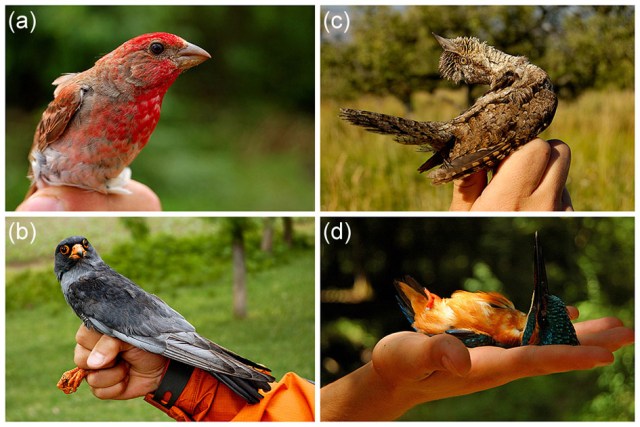
Four representatives of the entire species pool: common rosefinch Carpodacus erythrinus (a), red-footed falcon Falco vespertinus (b), Eurasian wryneck Jynx torquilla (c), and common kingfisher Alcedo atthis (d). Photographs by Csongor I. Vágási.


Lay summary

The size and structure of primary feathers appears to vary greatly between species. The primary feathers form the outer wing and are used to propel birds through the air. Feathers consist of a central shaft called the rachis. Attached to and aligned perpendicular to the rachis are the barbs and attached to, and, again perpendicular to the barbs, are the barbules. Barbs and barbules together make the feather vane, which gives the feather its shape and surface area. Feathers become damaged over time so birds replace them through a process called moult, replacing old feathers with new ones.

Birds differ in the way they fly (different flight types), particularly in how much and how fast they beat their wings. Birds also have differing life history traits, i.e. living in different habitats, moulting feathers at different times of year and some migrate over long distances. Also, wing shape differs between species (e.g. long and narrow versus short, and broad wings). In this study, we examined the primary feathers of 137 European species to determine whether feather structure was related to life history traits and wing shape.

Flight type, habitat, wing morphology, and moult strategy all affected feather structure. Species characterized by low wing-beat frequency flight (soaring and gliding flight) had broader rachises and feathers with a lower density of barbs than birds associated with more active flapping flight types (high wing-beat frequency). Rachis width was primarily determined by wing shape. Our results suggest that species that flap their wings most vigorously during flight require denser feather vanes. The forces created by the air increase with flapping frequency and more dense feathers are likely to reduce the chance of air being forced through the feathers.

Barb and barbule density was highest in aquatic species, peaking within diving birds. Hence, the need for water repellency and resistance to water penetration may also influence feather structure.

In conclusion, the optimum feather morphology for flight and habitat for some species may conflict resulting in a compromise structure, for example, gliding and soaring flight selects for low barb density, while aquatic habitats select for high density.

Posted in Uncategorized | Leave a comment

News #41


Flight feather structure evolves to match habitat and flight requirements. This was concluded in a phylogenetic comparative study in which we used 4 flight feather structure parameters of 137 European bird species. We found that flight style (4 categories: flap-soaring, flap-gliding, continuous flapping and passerine type) and habitat (3 categories: terrestrial, riparian and aquatic) are highly significant predictors of primary feather structure. For instance, soaring and gliding birds have primary feather vanes with lower barb density than those that flap their wing at higher frequencies (i.e. continuous flappers and passerines). Moreover, the outer (distal) primaries of species having higher wing-beat frequencies was more wider relative to the innermost (proximal) primary than in less intensely flapping species, which had outer primary rachis width closer to that of the innermost primary. Regarding the effect of habitat type, we showed that aquatic species bear primary feathers with higher barb and barbule density, and within this habitat group diver species have even more densely ramified feathers than aquatic non-divers.

The manuscript was submitted to Functional Ecology where the editor-in-chief requested major revision based on the comments of referees. We are now working to improve this work by considering the highly constructive criticism raised by reviewers.

Our results were also disseminated at the conference entitled “Modern Phylogenetic Comparative Methods and their Application in Evolutionary Biology” held in Seville, Spain, 11-15 November 2014. Our results were presented by Orsolya Vincze, who won the runner-up prize for the best student talk. Congrats!

Authors marked with boldface are EvolEcol members, while asterisks indicate student authors.

Pap PL, Osváth G, Sándor K*, Vincze O*, Bărbos L*, Marton A*, Nudds RL and Vágási CI. Interspecific variation in the structural properties of flight feathers in birds indicates adaptation to flight requirements and habitat.

Posted in Uncategorized | 1 Comment

News #40


Our paper about the correlation between constitutive immunity, life histories and basal metabolic rate was published in Oecologia and can be accessed at the publisher’s site and our group’s publication list.

Posted in Uncategorized | Leave a comment

News #39


The great news series continues: our manuscript mentioned here and here was definitively accepted for publication in Oecologia. This is the first time – and hopefully not the last time – we make our way into this great journal. Below, EvolEcol member’s names are typed with boldface. Note that OV and JVS were undergrad students during the time of the study and manuscript writing.

Pap PL, Vágási CI, Vincze O, Osváth G, Veres-Szászka J and Czirják GÁ. 2015. Physiological pace-of-life: the link between constitutive immunity, developmental period, and metabolic rate in European birds. Oecologia (in press).

Posted in Uncategorized | Leave a comment

News #38


The Physiological and Biochemical Zoology paper mentioned here and here was published and the pdf can be accessed in the Publication list of the EvolEcol group.

Pap PL, Sesarman A, Vágási CI, Buehler DM, Pătraș L, Versteegh MA and Banciu M 2014. No Evidence for Parasitism-linked Changes in Immune Function or Oxidative Physiology over the Annual Cycle of an Avian Species. Physiological and Biochemical Zoology 87: 729–739.

Posted in Uncategorized | Leave a comment

News #37


The PLoS ONE paper mentioned here and here was published and can be accessed here.

Diaz-Real J, Serrano D, Pérez-Tris J, Fernández-González S, Bermejo A, Calleja JA, De la Puente J, De Palacio D, Martínez JL, Moreno-Opo R, Ponce C, Frías Ó, Tella JL, Møller AP, Figuerola J, Pap PL, Kovács I, Vágási CI, Meléndez L, Blanco G, Aguilera E, Senar JC, Galván I, Atiénzar F, Barba E, Cantó JL, Cortés V, Monrós JS, Piculo R, Vögeli M, Borràs A, Navarro C, Mestre A and Jovani R 2014. Repeatability of feather mite prevalence and intensity in passerine birds. PLoS ONE 9: e107341.

Posted in Uncategorized | Leave a comment

News #36


Two good news for our group:

(1) Our manuscript about the species-specificity of feather mite intensity and prevalence mentioned in the previous News post was accepted for publication in PLoS ONE.

(2) It was long time ago that we submitted a manuscript about the ecological and life history correlates of constitutive innate immunity across many European bird species for review in Journal of Evolutionary Biology. It was rejected at that time with the major critique being the lack of clear focus. After rethinking the subject and changing somehow the focus, we revised the manuscript and submitted to Oecologia. In the first round was rejected with possibility to resubmit. We took the opportunity and resubmitted a revision by taking into account the plentiful constructive comments raised by reviewers. This version was now conditionally accepted by requesting minor modifications. EvolEcol member names are typed with boldface.

Pap PL, Vágási CI, Vincze O, Osváth G, Veres-Szászka J and Czirják GÁ. Physiological pace-of-life: the link between constitutive immunity, developmental period, and metabolic rate in European birds.

Abstract: Constitutive innate immunity is the first lined of defence against infections, but the causes determining its variability among species are poorly understood. The pace of life hypothesis predicts that species with a fast speed of life, characterized by high energy turnover and short developmental time, invest relatively little in defence in favour of growth and early reproduction, whereas ‘slow-living’ species are predicted to invest more resources into costly defence. We conducted phylogenetic comparative analysis on 105 European bird species and determined that the number of leukocytes, and the levels of natural antibodies (NAbs) and complement, measured on adult birds, increased or tended to positively correlate with the length of incubation period. However, we found that the length of incubation and fledging periods have opposite effects on immune defence (i.e. immune parameters show a negative association with the length of fledging period). Our results suggest that the contrasting effects of the incubation and fledging periods are related to the timing of the development of immune cells and of NAbs and complement, which largely mature during the embryonic phase of development. In support of this hypothesis, we found that species with a long relative incubation period [i.e. whose total pre-fledging developmental time (incubation plus fledging) consists largely of the incubation period] invested more in constitutive innate immunity. Finally, in support of the pace of life hypothesis, for a subsample of 63 species, we found that the basal metabolic rate significantly or tended to negatively correlate with immune measures.

Posted in Uncategorized | 2 Comments

News #35


Feather mites are among the most common ectosymbionts of birds. Despite their ubiquity, the bird–mite relationship is poorly studied. As a result of a large European collaboration, several scientists contributed their own data about feather mite prevalence and abundance quantified on different bird species. This yielded a highly valuable and huge dataset, which is continuously growing (now 119 species and 75944 individuals). Taking the advantage of this unprecedented dataset, we previously showed that feather mites are not parasitic symbionts of birds as formerly claimed (Galván et al. 2012). As a next step, we tested whether feather mite prevalence and intensity are species-specific traits, i.e. host species differ in a consistent manner. For this, we analysed the repeatability of the above two mite measures by ruling out several potentially confounding variables. We found that prevalence has a moderate, while intensity a low, but significant repeatability. Exploring what factors contribute for the relatively large overlap between species clearly deserves further enquiry. Our manuscript was submitted for review in PLoS ONE and was provisionally accepted with a “minor revision” decision. EvolEcol member names are typed with boldface.

Diaz-Real J, Serrano D, Pérez-Tris J, Fernández-González S, Bermejo A, Calleja JA, de la Puente J, de Palacio D, Martínez JL, Moreno-Opo R, Ponce C, Frías Ó, Tella JL, Møller AP, Figuerola J, Pap PL, Kovács I, Vágási CI, Meléndez L, Blanco G, Aguilera E, Senar JC, Galván I, Atiénzar F, Barba E, Cantó JL, Cortés V, Monrós JS, Piculo R, Vögeli M, Borras A, Navarro C, Mestre A and Jovani R. Symbiotic feather mite load is a species-specific trait in birds. PLoS ONE

Posted in Uncategorized | 2 Comments

News #34


Two updates:

(1) Our revised manuscript submitted for review in Physiological and Biochemical Zoology was accepted for publication. We will be back when the online early version is available. Till then, below you can find the abstract of the study. See also News #32 for further details.

(2) The article about the possible causes of feather holes was published online. For scientific purpose only, you can access the pdf here.

Pap PL, Sesarman A, Vágási CI, Buehler DM, Pătraș L, Versteegh MA and Banciu M 2014. No Evidence for Parasitism-linked Changes in Immune Function or Oxidative Physiology over the Annual Cycle of an Avian Species. Physiological and Biochemical Zoology (in press)

Abstract: Temporally changing environmental conditions occur over most parts of the world and can exert strong pressure on the immune defense of organisms. Seasonality may result in changes in physiological traits over the year, and such changes may be essential for the optimization of defense against infections. Evidence from field and laboratory studies suggest links between environmental conditions, such as infection risk, and the ability of animals to mount an immune response or to overcome infections; however the importance of parasites in mediating seasonal change in immune defense is still debated. In this study, we test the hypothesis that seasonal change in immune function and connected physiological traits are related to parasite infection. We sampled captive house sparrows (Passer domesticus) bimonthly over 14 months and compare the annual variation of 12 measures of condition, immune function, antioxidant status and oxidative damage among birds naturally infested with coccidians or medicated against these parasites. We found significant variation in 10 out of 12 traits over the year. However, we found little support for the parasite-mediated change in immune functions and oxidative status in captive house sparrows. Of the 12 measures, only one was slightly affected by the parasite treatment. In support of the absence of any effect of coccidians on the annual profile of the condition and physiological traits, we found no consistent relationships between the intensity of infestation and these response variables over the year. Our results show that chronic coccidian infections have limited effect on the seasonal changing of physiological traits, and that the patterns of these measures are probably more affected by acute infection and/or by virulent parasite strains.

Posted in Uncategorized | 1 Comment